I’ve spent a lot of time over the last few years trying to build something real in the East Idaho electronic music scene.
I’ve played the shows. I’ve thrown the shows. I’ve helped other DJs get opportunities. I’ve put my own money into sound systems, venues, advertising, music, Atlantic Progression, and everything else that comes with trying to create an underground music community in a place where one doesn’t simply appear on its own.
And increasingly, I keep coming back to the same conclusion:
I want less dependence on social media, not more.
What Meta is doing with Facebook right now is helping validate that decision.
Facebook Wants Businesses to Pay Just to Use Facebook
For years, the deal with Facebook was pretty straightforward.
You could create a business page. You could build an audience. You could post your content. You could link people to your website, YouTube channel, Mixcloud, ticketing pages, or wherever else you needed them to go.
Of course, Facebook wanted businesses to advertise.
Fine.
I have absolutely no problem paying Facebook to run ads. If I have an event and want to put $100 behind an ad campaign to sell tickets, I’m purchasing advertising. There is a clear exchange of value there.
What I have a problem with is taking basic functionality that businesses have used for years, restricting it, and then telling those businesses they need another recurring subscription to get more access to it.
That is an entirely different proposition.
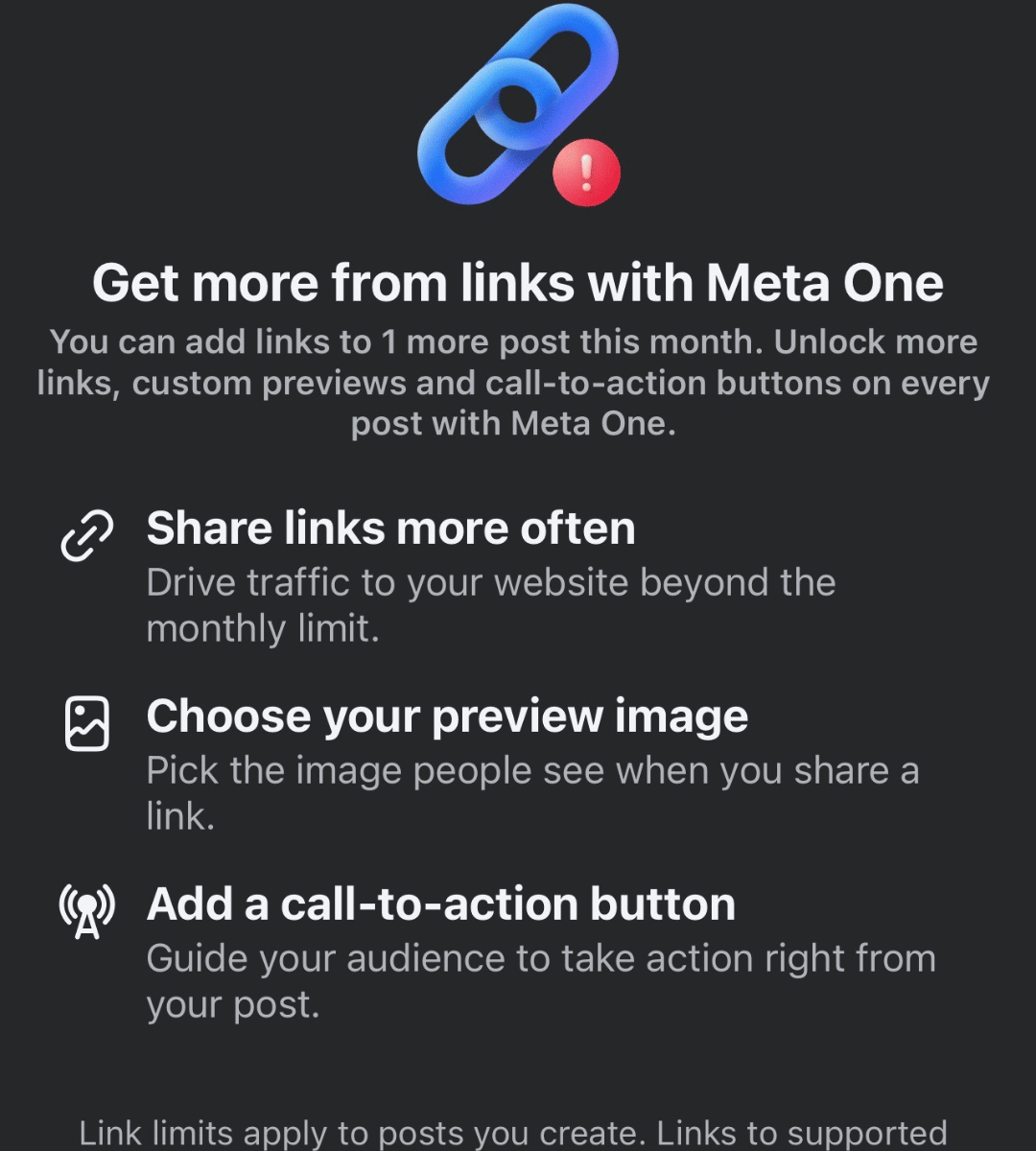
Meta has started implementing limits affecting how business accounts can post links directing people away from Facebook. Want more functionality? Meta Verified conveniently enters the conversation.
So now we’re moving toward a situation where simply using Facebook effectively as a business increasingly comes with a subscription attached to it.
And I’m not fucking paying it.
I Already Have Enough Subscriptions
This is something technology companies seem to have forgotten.
Every business already has subscriptions.
Every musician has subscriptions.
Every DJ has subscriptions.
Every independent record label has subscriptions.
Web hosting. Software. Plugins. Distribution. Email services. Cloud storage. Graphic design tools. Music pools. Streaming services. Business software. Domains. Marketing tools.
Everyone wants another $10.
Another $20.
Another $30.
Another recurring charge quietly hitting your card every month.
Eventually, you have to start asking what you’re actually getting for that money.
In my case, I operate both The Idahoan and Atlantic Progression.
Am I supposed to start paying recurring Meta Verified subscriptions for both identities just so I can continue effectively using Facebook to send people to things I’m already paying to operate?
No.
Neither The Idahoan nor Atlantic Progression generates enough money to justify piling more recurring expenses onto them just because Meta has decided functionality that used to be part of the platform should now be monetized differently.
Especially when I’m effectively being asked to pay for less usability than I previously received for free.
There’s a Word for This: Enshittification
This phenomenon has a name.
Enshittification.
The term was coined by writer Cory Doctorow to describe a pattern that has become painfully familiar across major technology platforms.
First, a platform tries to attract users.
It makes the product useful. Features are plentiful. Barriers are low. The company wants everybody there because growth is everything.
Once enough users are there, businesses have an enormous incentive to follow them.
Then businesses become dependent on the platform.
Your customers are there.
Your fans are there.
Your audience is there.
So you build your Facebook Page. You build your Instagram account. You accumulate followers. You create events. You post content. You tell everyone to follow you.
Then the economics begin changing.
Organic reach declines.
Advertising becomes increasingly important.
Features get restricted.
More functionality gets placed behind paid services.
Eventually, both sides of the marketplace are being squeezed because leaving becomes difficult.
The users don’t leave because everyone they know is there.
The businesses don’t leave because all the users are there.
And the platform gets to sit in the middle and extract more value from both.
That’s enshittification.
And Facebook is giving me fewer and fewer reasons to participate in it.
The Timing Is Almost Perfect for Me
The funny thing is that this is happening right as I’m already changing my relationship with the East Idaho event scene.
I currently have two venue shows left in Idaho Falls.
’Til Death Do Us Part at The Gem on August 29.
Then:
Slime Pit 3 at The Heart on November 28.
Those are the two remaining venue events where Facebook is genuinely useful to me as an event promoter.
I’ll create the events.
I’ll promote them.
I’ll run Facebook ads.
I’ll use the tools available to me because, again, I don’t have a problem paying Facebook for advertising.
But after Slime Pit 3?
I’m done throwing public venue shows for the foreseeable future.
That means I don’t need to keep feeding the Facebook event machine.
And that changes things considerably.
Hermitage Is the Opposite Direction
I’ve already been moving toward something different.
Hermitage.
Private parties. Smaller gatherings. Underground events. Experiences built around people who actually want to be there rather than trying to maximize reach on an algorithm.
And suddenly the idea makes even more sense.
Instead of spending all my energy trying to build somebody else’s platform, I need to concentrate on building infrastructure that I control.
My website.
My mailing list.
My music.
My label.
My relationships with the people who actually give a shit about what I’m doing.
That’s the direction I’m heading.
I Want Your Email, Not Your Follow
That probably sounds funny coming from someone who has spent years telling people to follow The Idahoan.
But increasingly, I’d rather have someone join my email list than follow me on Facebook.
Because Facebook followers aren’t really mine.
Facebook controls whether they see what I post.
Facebook controls how far the post travels.
Facebook controls what kinds of content get prioritized.
Facebook controls whether outbound links get penalized or restricted.
Facebook controls the advertising ecosystem around that audience.
And Facebook can change the rules tomorrow.
An email list is different.
If you voluntarily give me your email address because you want to know what I’m doing, I can communicate directly with you.
I don’t need to bombard anybody.
I don’t need to send three emails a week.
Hell, once a month is probably enough.
Here’s what I’ve been up to.
Here’s some new music.
Here’s what Atlantic Progression released.
Here’s what’s coming next.
And here’s where we’re gathering.
That’s it.
No algorithm deciding whether you’re worthy of seeing it.
Maybe Going Underground Means Actually Going Underground
I’ve talked a lot about moving further underground.
Until recently, I thought primarily about that in terms of events.
Smaller parties.
Private locations.
Community.
Word of mouth.
People knowing people.
Hermitage.
But maybe going underground also means reconsidering the entire digital infrastructure surrounding it.
Maybe I don’t need Facebook to be the center of everything.
Maybe Facebook becomes a billboard.
I put something there occasionally. People see it or they don’t. Maybe I run an advertisement when I actually have something worth advertising.
But the relationship itself happens somewhere else.
My website becomes home base.
My email list becomes the direct line.
Hermitage becomes the gathering.
Atlantic Progression becomes the outlet for the music.
And social media becomes supplemental rather than foundational.
That feels considerably healthier to me.
Atlantic Progression Is the Harder Question
The one piece I haven’t completely figured out yet is Atlantic Progression.
A record label obviously needs promotion.
Artists deserve promotion when they’re releasing music through the label. We need ways to introduce those records to listeners and send people to streaming platforms, stores, YouTube, SoundCloud, artist pages, and everywhere else the music lives.
So I’m not pretending I have the entire answer yet.
I don’t.
I’m going to have to figure out what promotion looks like for Atlantic Progression in a world where I deliberately reduce my dependence on Meta.
Maybe email becomes part of that.
Maybe the website becomes more important.
Maybe YouTube becomes more important.
Maybe direct relationships with DJs, listeners, artists, labels, blogs, and curators become more important.
Maybe it’s a combination of all of them.
But I know what the answer isn’t.
The answer isn’t blindly adding another recurring subscription because Meta deliberately made the free product worse.
I’m Not Leaving Facebook Tomorrow
This isn’t some dramatic “GOODBYE FACEBOOK!!!” post.
I’m not deleting everything tomorrow.
I’ll still have a presence.
I’ll still post things.
I’ll still advertise when advertising makes financial sense.
And I still have two Idaho Falls venue events that I intend to promote properly.
But I’m changing what Facebook means to what I’m building.
That’s the important distinction.
Facebook doesn’t have to be headquarters.
Instagram doesn’t have to be headquarters.
No social network has to be headquarters.
The website is headquarters.
That’s something I’ve increasingly come to believe.
Social media should point toward what I own rather than everything I own existing to feed social media.
This Is Exactly Why I’m Building Hermitage
The more centralized and monetized the internet becomes, the more interested I become in small, direct communities.
That’s part of what Hermitage represents to me.
It’s not about becoming antisocial.
It’s about becoming less algorithmic.
I’d rather have 100 people who genuinely care about this community than 10,000 followers an algorithm may or may not allow me to reach.
I’d rather send one monthly email to people who asked to receive it than constantly manufacture “content” because a social network demands engagement.
I’d rather throw a private party for people who understand what we’re building than spend weeks begging an algorithm to sell tickets to strangers.
And I’d rather spend my limited money on music, artists, equipment, events, websites, and experiences than another fucking subscription.
Meta can do whatever it believes is best for Meta.
That’s their business.
But I can also decide what’s best for mine.
I have two public Idaho Falls venue shows left.
After that, things change.
I’m going underground.
AI Disclosure: The thoughts, opinions, experiences, and ideas in this article are my own. I developed the original content through spoken dictation, which was transcribed into text. I used AI as an editing tool to help organize and format that material, correct errors, and improve clarity and readability. AI was used to assist with editing and presentation, not to originate the views expressed in this article.